

Doing Everything Right and Getting Nowhere
For most of my fifties, my fasting glucose numbers were the first thing I thought about when I woke up and the last thing I thought about before I went to sleep. Not dangerously high, my doctor never used words that scared me, but high enough that every annual visit felt like a conversation about what we were going to do next. I was eating well, walking every morning, sleeping reasonably. I was doing everything right, and the numbers just sat there, stubborn and slightly too high, year after year.
I had tried cinnamon supplements twice before. The first time was a bottle from a pharmacy, 1,200mg capsules, the kind that are everywhere. I took them faithfully for two months and felt nothing. Not a change in energy, not a change in readings, nothing. I chalked it up to wishful thinking and moved on. The second time I was more deliberate. I did research, chose a product that specifically said Ceylon, paid more for it. Same result. After that, I quietly decided that cinnamon was one of those things people talked about online that did not actually work in real bodies.
A Friend Told Me the Problem Was the Form, Not the Ingredient
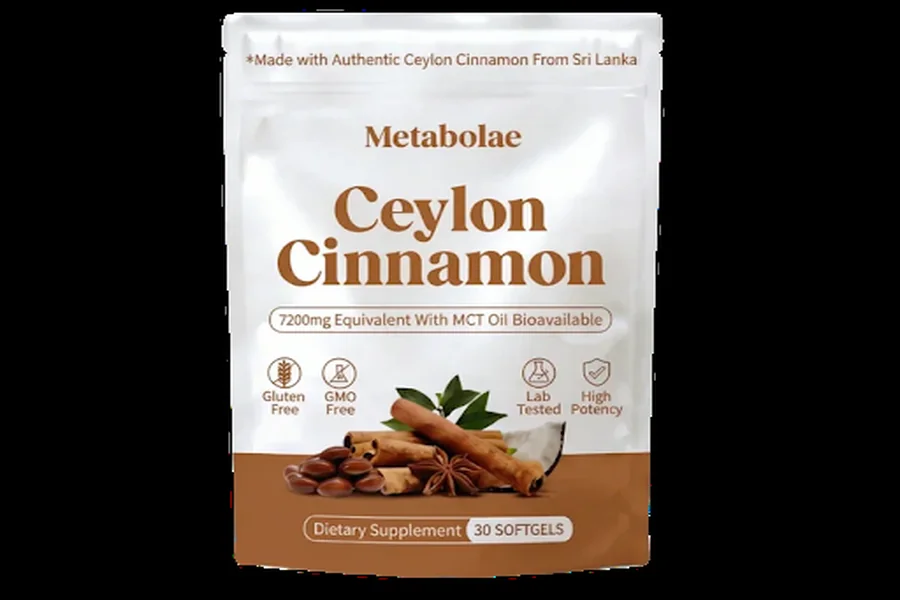
A friend changed my mind. She is two years older than me, manages her health carefully, and does not recommend things she has not tested herself. She told me the problem was not the cinnamon. It was the form. She explained that cinnamon’s active compounds are fat-soluble, which means a dry powder capsule without a fat carrier moves through the digestive system largely unabsorbed. I had been taking supplements for two months that were mostly passing through me. She had switched to Metabolae Ceylon Cinnamon softgels about four months earlier and asked me to look at the formulation before I dismissed the idea entirely.
I looked. The product uses a 12:1 concentrated Ceylon extract suspended in MCT oil. One softgel delivers the equivalent of 7,200mg of raw Ceylon cinnamon bark, in a form the body can actually absorb because the fat carrier is already built in. The cinnamon is sourced from Sri Lanka, verified as genuine Cinnamomum verum, and every batch is independently lab-tested for coumarin content. That last point mattered to me. One of the things I had read during my previous research was that Cassia cinnamon, the kind in most supplements, contains enough coumarin to become a concern with daily long-term use. Ceylon carries almost none. I wanted something I could take every day without quietly wondering whether it was doing something I could not see.
The First Few Weeks
I started in October. The first two weeks I noticed small things: slightly more even energy in the afternoons, fewer moments where I wanted something sweet after lunch. I did not read much into it at first. I had wanted cinnamon supplements to work before, and I knew how easy it was to talk yourself into noticing things that were not there. I made a deliberate decision not to track anything or pay close attention. I did not want to manufacture a result by watching for one.
By week four I was telling myself it was probably placebo. But the afternoons were different in a way that was hard to dismiss. I had spent years relying on a second cup of coffee around two o’clock, not because I wanted it, but because without it the afternoon would go sideways. That stopped happening. I did not notice it as a change at first. I noticed it when I realized I had not made that second cup in ten days.
By week six something had genuinely shifted across the board. The low-grade fatigue that had become so familiar I stopped recognizing it as fatigue was gone. My sleep was more settled. The cravings that used to build up by mid-afternoon, the kind that sent me to the kitchen for something I did not really need, had quieted down. I was not watching the clock waiting for my next meal. My days had a steadiness to them that I had not felt in a long time, and I was only slowly beginning to accept that it was real.
What the Numbers Said in January

In January, I had my regular blood work done. I had not told my doctor I was trying anything new. I wanted to see what the numbers said before I said anything. My fasting glucose was the lowest it had been in fifteen years.
My doctor asked what I had changed. When I told her about the formulation, the MCT oil delivery, the 12:1 concentration, she did not brush it off the way I had half expected. She said the fat-solubility point made scientific sense, and that most people using cinnamon supplements were working with a fraction of what the research actually suggested was needed. She asked me to keep going and come back in six months.
I have been on it for eight months now. I take one softgel in the morning, before breakfast, and it has become as automatic as anything else in my routine. My numbers have stayed where they landed in January. My energy is steady in a way I had stopped expecting it to be. I still walk every morning, still watch what I eat, still make the same choices I was making before. I am not going to tell anyone this is a cure for anything, because it is not, and because everything else I do still matters. But something changed when I stopped taking cheap powder capsules and started taking something formulated to actually absorb. I had the right idea three years ago. I just had the wrong product.